Wednesday, 10 July 2019

KHS Electric Bike


KHS Extended 2.0 Review

 I’ve been interested in the e-assist bicycle genre for some time. Until about a year and a half ago I was riding to work a couple of days a week on one of my normal bicycles, an old touring bike last used for touring in 2003. This worked fairly well most of the year as the start of my commute each day is a half-kilometre climb and the very low gears were ideal for legs which hadn’t yet woken up. The problem with it is was that from June through September it was very difficult to avoid getting sweaty and arriving for work in an office where wet clothing is not really acceptable. 

For 2019, KHS introduced 4 different models of e-assist bicycles, including the Extended 2.0. Here are the specs:

Frame
Alloy 6061 w/Custom Formed TT w/C/S Disc Mount, w/Replaceable Derailleur Hanger
Fork
SR XCE28, 80mm
Headset
Threadless 1-1/8, Zero Stack
Rims
Weinmann XTB26 Alloy, 700c x 36H, Doublewall
Hubs (F/R)
F: Aikema 250 Watt Motor; R: Alloy Disc, QR, Cassette
Tires
Kenda Kwick, 700 x 40c, 30TPI
Spokes
14G Black, 36X36
Derailleur, Front
n/a
Derailleur, Rear
Shimano Altus M2000
Shifter
Shimano Altus M2000 Trigger
Chain
KMC X9
Crankset
Samox Forged, 36T w/Guard
BB
Cartridge Bearing
Cassette
Shimano CS-HG201-9, 11-36, 9-speed
Pedals
Resin ATB Platform w/DU Bearings
Seatpost
Alloy micro-adjust, 27.2x350mm
Saddle
KHS Sport, Dual Density
Handlebar
Alloy, 31.8, 680X30mm
Stem
Alloy 3D Forged, Threadless 4-bolt, 7-degree, 31.8mm
Grips
KHS Sport, Dual Compound
Brake Levers
All Alloy Linear Pull
Brakes
Bengal Cable Disc, MB606, 160mm Rotors Wave12 w/ABS System
Color
Matte Gray
Frame Size
S/15, M/17, L/19
Extras
Battery 36 x 12.8 Ah / 460 Wh, Alloy Rear Carrier, Kickstand, Bell
e-Info


6-Hour Charge Time / 2 Hour Run Time / Up to 40 Mile Range


The electric motor unit on this bike is built into the front hub and offers a maximum output of 250 watts. In practical terms, this provides very real assistance when the rider is actually pedaling, particularly uphill. It is not like some of the other electric bikes commonly seen on Bermuda’s roads which have 500 watt (or more powerful) motors and can carry the rider along without any pedaling input. These bikes are more like electric mopeds to me rather than true e-assist machines. With the KHS, you don’t pedal and you get no help!
The rest of the bike is built and assembled to KHS’s usual standard, i.e. quality 6061 alloy frame, decent suspension fork and basic but tough drivetrain components. The braking is handled by Bengal cable-operated discs controlled with standard linear-pull levers, giving decent stopping power which is better than standard rim brakes. The gears required a slight adjustment after the first ride but have worked faultlessly during the six weeks of testing.
Battery power has been better than I expected. The specs say up to 40 miles between charges and I would say that’s realistic. I ran it for 37½ hilly miles and the indicator still showed some charge left at that point. My daily commutes include a number of hills and vary between 8 and 11 miles usually. I can do three days between charges routinely and have not yet found myself half way to work with a spent battery. For anyone who lives within a dozen miles of Hamilton this is a viable transportation option. If you live in Somerset and work in St George’s you’ll need to charge the battery while you’re at work J
The lowest gear available on this machine is 27 inches, which is not that low in view of the ultra-low ratios available on many modern road and mountain bikes. However, I have yet to use the lowest gear under any conditions due to the motor-assist nature of the bike. Typically, I don’t go lower than the third-lowest and I’m not a super-fit and highly-trained rider. Fitter riders will find they can use the top two or three gears for most of their riding.
A note of caution to would-be racers…..the e-assist function drops off sharply once you reach around 16mph and after that you will find increased resistance created by the non-functioning motor to be a serious deterrent for any high-speed shenanigans. Stay below that speed and your ride will likely see you expending about a third of the output you would use in riding your standard bike at the same speed. That's the difference for me between getting soaked and not getting soaked!
This bike conforms to the legal requirements for e-assist bikes in the UK and most EU countries. I feel sure that this sort of regulation will eventually show up at TCD in Bermuda and this is one machine which should be "TCD-ready".
I will be continuing the testing so check back for long-term updates from time to time. After the first three weeks of testing I switched the stock saddle to my preferred model....saddles are very much an individual taste item and while there was nothing wrong with the one which came with the bike and I'm sure it will suit a lot of people, it might have become a problem for me in the long term 😉

Monday, 20 June 2016

SUMMER BIKE SALE!

Once again its been a long time with no post but this time there's something a little different for you.....our sizzling Summer Bike Sale!
We have a few new bicycles at the shop which need to find riders so we came up with some pretty aggressive reductions to see if that might help move them to new homes. Please note that these are for sale in Bermuda only and prices are in Bermuda dollars, cash or card. We can probably be persuaded to take US dollars as well :-)

First off is the KHS Flite 500 road bike.Available in 52cm size it features a hydroformed alloy frame with carbon fork and carbon chainstays for a comfortable ride and optimal power transmission. 20-Speed Shimano 105 gearing and a compact crankset provide a wide range of gears ideal for Bermuda's roads. Original price was $1,420.00 and the Sale Price is $994.00.

Next up is the Free Agent Champ BMXer. This is a standard 20" wheel BMX bike from one of the top builders in the business. One size fits all. Single speed and equipped with coaster brake and rear wheel linear-pull brake. Was $335.00 and now reduced to $260.00. Several colour options available.


For His and Hers bikes, we have the Manhattan Cycles Green 3 in a 17" Ladies and 20" Gents. Colours as shown.

This bike has classic roadster styling, front and rear linear-pull brakes, alloy rims with stainless spokes and a low-maintenance 3-Speed Shimano hub gear. Here is a bike which is great for summer cruising, commuting or just flouting a little retro style. The price has been reduced from $665.00 to $465.00.


Only one left of the KHS Aguila 29er in size Large. The fork features hydraulic lockout and 100mm of travel. Disc brakes are hydraulic and the Shimano drivetrain is 27-Speed to easily cope with any terrain. The original sticker price was $1,070.00 and we'll be happy to let this last one go for $825.00.


Finally, we have the KHS Vitamin A fitness bike. Suitable for on-road use or light trail riding it features a 21-Speed Shimano drivetrain, lightweight alloy frame with cromoly fork and linear-pull brakes for excellent stopping power and simple wheel removal. This bike is reduced from its original shop price of $625.00 to $499.00. Available in Small and Medium.


For further info on availability, please send us a message or call on 232-2103 or 532-2103. Once again, Bermuda availability only and prices are good until they're gone!

Wednesday, 2 December 2015

To torque....or not to torque!

While working on a client's bike the other week I found a flaw which could have conceivably resulted in a nasty accident for him. Note that he had been riding the bike with no indication of a problem right up until then.

Take a look at these photos:


As you can clearly see, the stem clamp failed when I tried to remove it...and not at one bolt but at all four! 

Your immediate reaction to this might be "I'll be sure not to buy that brand of stem" but the truth of the matter is that this brand of stem is excellent and I have used them many times on many different bikes with no problems. The issue actually is all about torque. 

Modern lightweight equipment is made to be assembled with very specific torque guidelines (level of tightening). In this case all four bolts were over-tightened, setting up stress risers in the metal which resulted in the hairline cracks around the area where the bolts seat and eventually a complete fracture. The problem would not have occurred if whoever did the initial assembly had observed the torque value printed or engraved into the body of the stem (or the instructions which came with it) and had been sure not to exceed it. 

I've met a number of people over the years who think they can do safe assembly without using a torque wrench but why take the risk? Using a good torque wrench can help to prevent a lot of potential problems and is absolutely essential with carbon bikes and components.

Wednesday, 5 August 2015

Just completed last week.....a beautiful custom Pedal Force RS3 ISP bicycle.
The customer supplied his own well-used two-year old Dura Ace 9000 mechanical groupset and saddle. Everything else was new, including a sparkling set of iRT 38C Carbon Clincher wheels. This beauty has already been christened "B-52".
He reports that it rides like a dream, is easily a match on the hills for his two other bikes and is even leaning towards the opinion that it may be quicker into the wind than all of them. Time, of course, will tell.
And just as a footnote....this Dura Ace 9000 equipment functions superbly even though it has somewhere in the region of 12,000 to 15,000 miles of hard riding on it in all weathers. The only new bits have been chains and brake pads.

Monday, 6 July 2015

Here's something that has nothing at all to do with bikes or riding them!

For anyone who doesn't already know, I'm in Boston at the moment with Sheila who has been here for medical treatment and surgery at Brigham & Womens Hospital. This has been a successful experience thus far and on Friday, July 3rd she was advised by her surgeons that she would be discharged from hospital on the Fourth of July. This news immediately filled both of us with feelings of great patriotism even though neither of us is an American. Little did we understand the process of being discharged from a top drawer American medical institution!
If you're ever in hospital in Bermuda you should know that the biggest challenge you face once the physician handling your case discharges you is that the various members of his support squad immediately forget that you exist. You're then compelled to keep pressing the Call button or sending attending family members to search for them in an effort to remind them that you're still there and would like to go home. This can take most of the day or, if there's a shift change during this time, perhaps into the next day. 
At BWH the wait can be lengthy but the time is filled with visits from all sorts of nice people representing various post-surgical services. In Sheila's case, she had very thorough examinations by the departments of physical therapy, occupational therapy and speech therapy. In each case she answered many of the same questions plus went for several pleasant walks all around the ward and up and down stairs. All of these tests were passed with flying colours....we thought we'd be out the door in seconds! 
We then discovered that's not exactly how it works. All of these kind folk then have to write reports which they then must submit to the poor surgical resident whose unfortunate lot it was to be working on the country's most important summer holiday. Only then would we be "signed" out. After that, all the discharge papers and prescriptions needed to be assembled with the nurse-in-charge finally giving us a complete debrief followed by a question and answer period. To put things into perspective, the discharge process began around 10.30 a.m. and we walked out of the ward at 6.20 p.m.
Now was my chance to actually play a useful role in the proceedings...or so I thought. Sheila and I took the elevator from the tenth floor to the lobby of the mostly-deserted hospital. The plan was to take a taxi back to Cambridge Street but I reasoned that it would be easier to fill the prescriptions we needed at the CVS pharmacy about two blocks away than to try to go out later in the evening and pick them up. Feeling quite pleased with myself at coming up with this clever strategy I parked Sheila in a comfortable chaise, armed her with her smartphone and set off on the quick side-trip to CVS. 
The pharmacy itself was easily located and was also open. I was beginning to think I was on a bit of a roll until I walked up to the shuttered prescription counter and read a small printed note which said the dispensing side was closed and that to fill any prescriptions I should take myself off to the CVS dispensary at Boston Children's Hospital which was a three minute walk away. 
After briefly panicking and thinking of trying to find the Walgreen's somewhere near the subway stop I'd got off earlier in the day and a healthy stroll from where I was, I walked out of the shopping center and round the corner to find the Children's Hospital staring me in the face. I was back on that roll again!
I picked my way through the yellow tape guiding pedestrians through the labyrinth of re-modelling being done to the hospital's front entrance and approached the Information desk. Security at this hospital is a step up from BWH. My identification was scanned and I was given my very own visitor's pass which was to be clipped to my clothing. I was then directed to a pair of security guards, one of whom accompanied me on the key-only elevator to the second floor where CVS was located. I was impressed to say the least and would feel confident that if I had a child being treated at BCH he or she would be most unlikely to be abducted.
Once in CVS the pharmacist was very helpful, assured me that my Rx card would be honoured and asked me to take a seat for twenty minutes while he sorted the prescriptions. While I was sitting there looking at pharmacist-of-the-month photos on the walls and flipping through various pharmaceutical leaflets, a man came in towing behind him a boy of about four years who had the worst hacking cough I have ever heard....believe me, this kid was in the right place! All I could think was that I needed to keep a wide margin between him and myself. A bit of a heated discussion ensued between the pharmacist and the child's father over payment and I started to worry that this might drag on well into the evening. However, it was sorted out quickly and they mercifully left the premises instead of sitting down to wait with me for their prescription to be filled and infecting me with whatever dreadful malady the poor waif was suffering from.
Once in possession of the required drugs, I then followed a reverse process back through security to extricate myself from the building and with this done, determined by frenzied text that Sheila had not got up and wandered off. The rest of the return trip to BWH was uneventful and Sheila was very understanding as she knows well my propensity for losing any sense of direction at all when in a city. Once reunited, we were soon in a cab and on our way to the condo in Cambridge :)


Sunday, 5 July 2015

Cycle Cellar's new face

The bike shop was dealt an untimely blow when we discovered in June that we had to make an unscheduled visit to Boston for medical treatment for Sheila. This effectively meant that the shop had to be closed for however long the Boston trip would last.
Just when things were looking really bleak my good friend Kelly Sullivan stepped forward and has agreed to open the shop for business on Saturdays. Kelly has had lots of experience as a rider over the years and I was able to give her a mini-crash course on how the shop operates. Her skills are mostly in the sales area so there will be no service in our absence.
Kelly has already had a positive impact on Cycle Cellar. She brings fresh views and a can-do outlook to the little shop. The positive comments are starting to roll in  and we are so happy to have her looking after things!

Friday, 5 June 2015

The final word on compact cranks

The experiment is over. I fitted a 46 tooth outer ring so ended up with 46/34 x 12/23 gearing. This was definitely an improvement but I think I may just be too used to a cassette with more 2-tooth jumps between gears so couldn't gel with the straight block run from 12 through 19.
So.......from this weekend it will be a standard 130 mm BCD crank fitted with 50/38 rings and a 12/25 at the rear dérailleur. All of which means that for me I still don't see the point of using a compact crank in Bermuda for competitive riding.
For my next post I plan to cover a bike build I'll be doing for one of my favourite clients :)

Tuesday, 19 May 2015

Bermuda Day and the Sinclair Packwood Memorial Road Race

Bermuda Day is celebrated next Monday on May 25th. Our first "real" holiday of the year. It's a day when we have the big parade in Hamilton in the afternoon, fitted dinghy racing, the half marathon and some fast and furious bike racing.
Thinking about this year's edition of what is arguably Bermuda's premier showcase for cycle racing, it's not difficult to cast one's mind back over some of the great races from previous years. There are a number which stand out in my mind because the winner was able to get away from the bunch and ride solo to the finish in what is usually billed as a "sprinters" event with the bunch arriving at the finishing straight more or less intact. However, without a doubt the best-ever victory was that perpetrated by Jeff Payne in 1997 when he and another rider got away early in the race and effectively did a two-up time trial all the way to the finishing straight where he out-sprinted his companion to cross the line first. 
Jeff is one of those rare perennial athletes. He was 58 years old then and while one of the strongest time triallists in Bermuda at the time he knew he was not the favourite for this "sprinters" event. His companion was a comparative (but very strong) novice and Jeff reasoned that if they could get enough of a lead to remain out of sight of the main group they might stay away until the finish and that's exactly what happened. Speaking with some of the other riders after the race it appeared that everyone else looked to the pre-race favourite to lead the chase and by the time they realized that he was having none of it the race was over except for the minor placings. 
It's interesting to note that Jeff is the only person to have won this race and also the Bermuda Day Half Marathon, a feat which he accomplished in 1980. I think its unlikely we will see that double repeated for quite some time yet.

Wednesday, 13 May 2015

More on compacts.......

So I've continued to ride with the 50/34 - 11/23 gears. Still not getting it. Top gear is way too high and the shifts from small ring to big are like a scary movie.
My dilemma is that I love my titanium bike because it is an evolution of all things comfortable and responsive and smooth......other than the current gearing.

Then came the moment of cranial clarity I was waiting for. Why not get a smaller large ring to fit my current crankset that allows less dramatic inter-ring shifts and drops the big gear to a more reasonable 110 inches or so?
This is exactly what I've ordered and on its arrival I will install and evaluate for the benefit of us all!

Monday, 4 May 2015

Compact gears in Bermuda

I've noticed over the last few years that compact gearing (basically substituting a 50/34 crankset for the old standard 53/39) has been creeping into the road racing and triathlon communities in Bermuda.
Drawing on my own limited and not very recent experience with bike racing, I don't recall ever running out of gears at the bottom end and usually kept the bottom 39/25 or 26 as a "bail-out" gear although most of the courses I raced on didn't have any really steep inclines. That said, I've not come across any hills on the public roadways on the island that I've not been able to haul myself over with a little huffing and puffing using a 39/25 bottom gear. Which leads me to the question of why bike racers and triathletes, who are VERY much stronger than I, feel the need to use bottom gears of 34/25 or even 28 for training and racing?
Thus I fitted one of my own bikes out with a compact crankset and 11/23 cassette, which approximates the gearing range on all my other bikes, and took to the road. I didn't find the experience unpleasant but couldn't warm to the huge 16 tooth difference between the front chainrings. Shifts were smooth enough but its so much more difficult to change down to the next lowest gear when dropping down to the small chainring, requiring about three up-shifts with the right lever while down-shifting with the left. Not nearly as smooth and easy as the single up-shift with the right and down-shift with the left which I'm used to using a 50/39 (yes, I normally use a 50 outer because it gives me a lot more usable gears) when performing this same task. 
One shouldn't form an opinion on something like this based on just a single 90 minute ride so I will continue with it for the next few months to see if I can adapt and if the whole concept grows on me. At this point its hard to see an advantage for racers over using gearing based around 53/39 rings. I can, however, see that this gearing would be ideal for use in hilly sportives, gran fondos or anywhere with long and/or steep climbs. One local rider I know, who doesn't race, swears by his compact gears but rides mostly in the big ring except for the multiple hill repeats he does several times a week and for him the gears seem to be perfect. I can also see that compact gears are great for anyone just starting out with a road bike and some of the new bikes I've sold have been equipped with 50/34 x 11/32 or even 11/34. A compact is also simpler to use for newbies than a road triple while maintaining a similar gear range.
I'll be back with more on compacts after I've put some miles on mine. Maybe I should swap that rear cassette......

Thursday, 30 April 2015

Rolling resistance and weight....

Have you noticed that wider rims and fatter tyres on road bikes are all the rage at the moment? Truth is, there's nothing really new about this at all. 
In the 1980s there was a trend towards narrower tyres based on the belief that "thinner is faster". To some extent this was true but to achieve lower rolling resistance the tyres themselves had to be pumped to a much higher pressure resulting in a harsher ride and skittish handling, especially in the 19 or 20mm widths popular at the time. A number of studies were done prior to 1990 which proved conclusively that fatter tyres did, in fact, roll faster and gave a smoother and more comfortable ride at a lower pressure than the ultra skinny versions. I recall that, all other things being equal, 700x28 was actually the optimal size.
So you might think, well why didn't the bicycle industry simply move up to 700x25 or 700x28? The main reasons for this were that manufacturers had invested a lot in the 'skinny is better' concept and most frames had limited clearance between wheel and frame tubes plus the wider rims required to safely mount wider tyres were a lot heavier. With the greater weight of 700x28 tyres over 700x20 this created a wheel package which was compatible with few frames at the time and increased the weight of the complete bicycle.
Fast-forward to the current era and we find that the improvements made in materials used to manufacture wheels have finally delivered on the promise of those studies from the '80s. You can now have great handling, improved comfort and lower rolling resistance without a significant weight penalty and providing your bike has the clearances to allow for today's fatter rubber. 

Thursday, 23 April 2015

Brake opinions

With all the talk about disc brakes for road bikes coming soon for professional cyclists, it made me think about how far road bike brakes have come since the 1970s. Until that time, brakes for road bikes were more of an afterthought for component makers than anything else and had changed little in design or functionality since the 1940s. Basically they worked sort of OK in dry conditions but it was a case of 'heaven help you' when it rained. At least things got better when steel rims were abandoned in favour of alloy.
Starting around 1990 or so with the introduction of the double-pivot designs, the effectiveness of road bike brakes took a big leap forward. There have been further refinements through the years with Shimano, Campagnolo and Sram all producing very effective braking systems right down to their entry-level components. Unfortunately, the major bicycle manufacturers don't always spec brakes to match the rest of the components and it continues to be an area where they typically save costs in an effort to offer a bike at a lower retail price. What typically happens is that your new carbon bike with Ultegra 11 speed gears will come with no-name or house-brand brakes which are not much better than the stuff which used to masquerade as brakes in the '60s. Not all non-system brakes are bad though with some decent units being offered by other brands, Tektro in particular. 
Brakes may not make you go faster but they are sure handy when you have to cut speed quickly and safely in any conditions. It may not be the sexiest upgrade you can make on your bike but if you have doubts about your current brakes there are worse things you can spend your pocket money on than a set of decent stoppers or at least some upgraded cartridge brake pads.
And in case you're wondering about disc brakes v. rim brakes for road bikes I'm keeping my thoughts to myself on that one for now...... :)

Tuesday, 21 April 2015

Wheel musings #2

So, what about hand-built wheels? Hand-built hoops used to come standard on reasonable quality bicycles. If you bought a bike fitted with a Shimano 105 group you usually got wheels built with 105 hubs, double-butted spokes and rims from companies like Mavic, Sun, Wolber, Ambrosio and many others. Sometimes the wheels were built by hand and sometimes by machine but whichever way they were done you could be sure that if you broke a spoke, any bike shop could replace it because they were standard spokes and all shops carried spares. Groupset hubs also typically ran for years with little or no maintenance and when they eventually got grungy your local shop could repack them with fresh grease and new ball-bearings, which were also pretty standard. 
So much for the good old days. Now your 105-equipped new bike is likely to come with wheels which might look flashy but usually aren't anywhere near the quality of the wheels described above. In any case, manufacturers assume that one of the first upgrades a buyer is likely to make will be the wheels so the standard wheels are frequently made with heavier or inferior materials and they wear out or break in a year or two. You then go back to the bike shop and they talk you into a set of $2,000+ wheels which are a different story altogether. Now you have wheels which are stiffer, lighter and might even be more robust than the original versions but your wallet is a whole lot lighter as well.
By now I think you may have figured out that I like hand-built custom wheels so perhaps I should provide some justification. First of all, you can choose hubs from Shimano, Campagnolo, DT Swiss, Chris King or a few other makers to suit your budget. Secondly, you can choose VERY good quality spokes, double or even triple-butted which are strong and fatigue-resistant. Finally, you can select really good and lightweight alloy rims which keep the rotating weight at the outer edge of the wheel as low as possible and thus improve handling and acceleration. You can also decide if you want the same number of spokes in the front and rear wheels or if you want fewer in the front. Front wheels only take about 30% of the load and aren't subject to the same drive forces generated by your legs on the rear wheel through the gears and chain. Talk to your wheelbuilder about lacing patterns although for most purposes three-cross delivers the best performance. To top it off, your hand built wheels will probably be lighter than most similarly priced factory wheels.
Aesthetics are a personal thing for sure and most people these days seem to prefer the industrial, brute-force look of factory wheels. For me, it's the shimmer of stainless spokes in the early sunlight of a Sunday morning that sets the tone for a great ride.

Monday, 20 April 2015

Wheel musings #1

Been thinking about factory-built wheels v. hand-built wheels......again! It seems to me that many of the wheelsets sold today by a large number of manufacturers are awfully expensive for what you get.
Its rare to find a set under a grand that doesn't have some sort of trade-off (or two), such as painted spokes v. genuine stainless spokes. Painted spokes are fine if you live in a very dry climate with low humidity but not so good in a place like Bermuda where a "dry day" is one with 60% relative humidity; and we all know that 60% is the exception rather than the rule. In partnership with the saltiness of our summer breezes, this isn't a very healthy environment for steel spokes with scratched painted surfaces.
It also seems to me that many of these sub-$1,000.00 wheels don't have decent quality hubs or have hubs with mediocre bearings. Frequently they are constructed with minimal spoke counts and at this level that usually means the rims are heavier because of extra material around the spoke holes. This creates wheels where much of the weight is at the outside edge of the wheel and is thus rotating weight (harder to get up to speed and with a negative effect on handling).
While the above issues can be significant, perhaps the most important factor is that many of these wheels don't represent a significant weight savings over standard 32 spokers. In many cases they are actually heavier but riders are prepared to overlook this because they look "flash" or "trendy". If I'm going to slap down a grand on a new set of hoops I'd like to think they might help me get over the hills a little easier!
Next post I'll share some thoughts on handbuilts.

Long time gone.....

I think its about time I started posting to this blog again. Let me see what I can come up with today.

Saturday, 23 July 2011

Pedal Force QS3-Sram Red-DT Swiss RR1450 Mon Chasseral

This build was completed a couple of weeks ago and what a beauty it turned out to be. The client is very pleased with the finished machine and enjoyed it so much on the first ride that he clocked up 100 miles! While that distance on a brand new bike is impressive in itself, it was all the more interesting because there was a howling easterly blowing all day and there was certainly no escaping it for at least 50% of the ride. We're hoping that the wind will be mostly at his back for the next several rides on this new superbike.

Thursday, 23 June 2011

A new bike build

Started another new bike build. Sram RED again but this time with DT Swiss Mon Chasseral Climbing Wheels. More pics when its finished.

Tuesday, 7 June 2011

Bermuda-flavoured jerseys

We're now offering these to our customers in Bermuda through an exclusive arrangement with the brand owners, Gosling's Ltd. They are made in the USA by VO Max. We have had the opprtunity to road-test one and found it to be every bit as good as the more usual offerings from other major manufacturers of cycling apparel. Sizes available are S, M, L, and XL (38, 40, 42 & 44). $79.95 each.
Interested parties should contact us at cyclecellar2@gmail.com


Kudos

Our very own sometime brevet-rider, cycle tourist and resident bike service specialist, Sheila, recently decided to upgrade her skills and knowledge by attending an intensive two-week course at The Bike Inn in the UK. The course covered the full gamut of cycle service and repair issues and included modules on a variety of topics including wheelbuilding and hydraulics. She achieved their Certificate of Attainment and is looking forward to putting what she's learned to good use in the workshop.
Well done, Sheila!
For more information on the courses offered at The Bike Inn, check out http://www.bike-inn.co.uk/

Custom-build

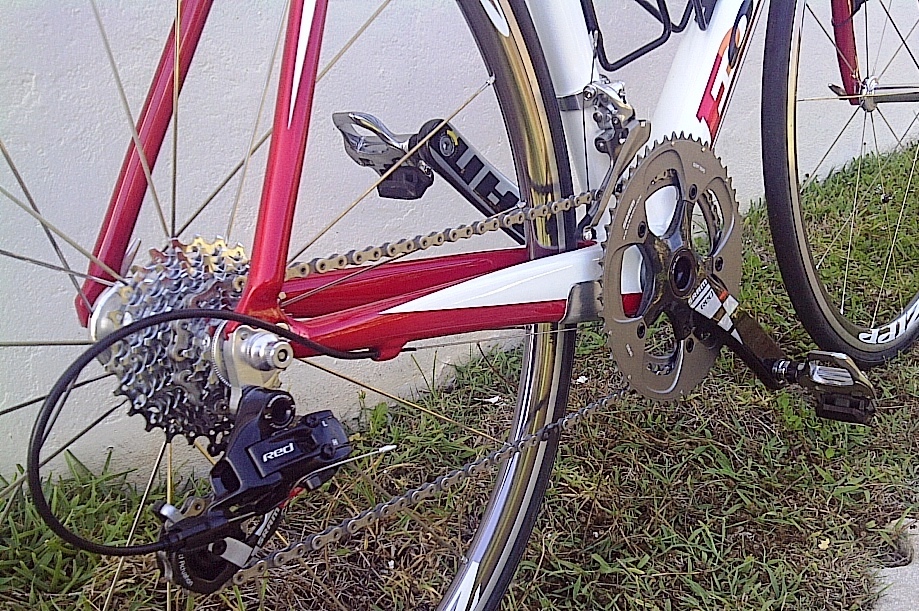
This week we did a custom build on a new Pedal Force QS3 for which the client had specified Sram RED components and Zipp 101 wheels.

All I can say is "Wow!". We've built bikes with groupsets from all the manufacturers and had used Sram Rival and Force before this, but this group is in a class of its own. Unfortunately, we won't get to ride the bike ourselves which is a real shame. These are a few of the high points:
Brakes - The reputation for these stoppers was well-known and the workstand is certainly no testing track but the quality and precision positively oozes. We've always loved Dura Ace and Record brakes but we now have a new favourite.

Shifting - The double-tap functionality was great as usual but the solid feel inspired a real confidence. Not sure how much of this is due to the lever/derailleur interaction or the Gore Ride-On gear cables and housing. These were included with the shifter kit which is a nice touch. Especially when you look up the replacement cost for a new set.

BB30 bottom bracket - The light weight and massive over-sizing inspires confidence. It was a dream to fit and appears to be very solid and stiff. While the bearing cartridges are over-sized compared to conventional or outboard-bearing BBs, we wonder if the smaller size of the sealed balls will have reasonable longevity? Time will tell.
Zipp 101s - What else can you say? These are simply amazing. Not the lightest alloy clinchers on the market but they have a character which makes them feel like a much more expensive wheel and they will prove to be fast and a good match for the RED components.

All in all a great bike which will hopefully give its owner thousands of miles of smiles!